
By Julianna Evans, BM, MM, PMP
Have you ever had that feeling of sheer panic on stage because you’ve forgotten a passage of your music from memory? The terror of public humiliation and the ridicule and self-doubt that follows an experience like that can be unbearable, and I know first-hand because I’ve been there myself. One of my first experiences with a memory fail was in high school during a concerto competition. I made one small memory slip on a passage and that began a snowball effect that resulted in me standing there stunned, not playing at all, for what seemed like an eternity (it actually amounted to three lines of music). I eventually got back on with my accompanist, but the pain of that experience really taught me a lesson about how to prepare for playing from memory that has sent me on a quest for the best practices.

1. Understand How You Learn
Everyone learns differently and part of becoming a better memorizer is to understand how you process and learn information. To better understand this concept let’s explore the the Four Main Learning Styles of Visual, Auditory, Tactile and Kinesthetic.
Visual Learners learn best from visual aides, seeing visual examples and in music being able to see the score in their head. This can be especially useful if you play piano or a stringed instrument that you can use for visual cues.
Auditory Learners learn best when information is spoken or relayed in a way where they are listening. This learning style is quite useful for memorizing music, but can be a pitfall if you rely on it alone.
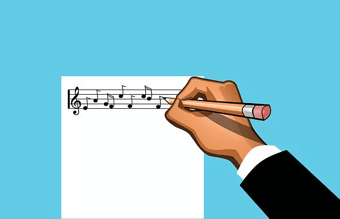
Tactile Learners learn best when they can write information down and take notes. This can come in handy when memorizing music by writing your part down by hand on manuscript paper.
Finally, Kinesthetic Learners learn best by “doing” and moving their body and muscles in a way that they’re creating muscle memory. A lot of musicians learn to memorize music this way, including myself, by repeating a passage so many times that they memorize a piece by how it feels under their fingers. All of these learning styles work for memorizing music, but don’t fall into the trap of relying solely on one style. Everyone can become a better memorizer if they know their learning style and work to build on the other styles.
2. Know and Learn Basic Music Theory (Visual/Intellectual)
Whether you’re new to memorizing music or you’re a veteran to the process, knowing very basic music theory can help immensely. For starters, being able to know what key you’re playing in throughout a piece, and whether you’re playing a scale, arpeggio, scales in thirds, what chord you’re on engages a specific part of the brain, strengthening the overall knowledge of a piece. If you can look at a piece of music and be able to identify these basic music theory concepts, the easier it will be to visualize in your mind’s eye where you are in the piece. Another visual learning tool is to follow the score along with listening to a recording. This not only reinforces visual learning, but strengthens auditory learning as well.
3. Practice With A Recording (Auditory)
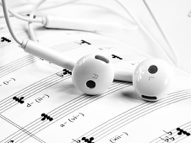
Being able to “hear” your piece of music in your mind is an important function to memorizing. Some practices that help with this learning style are listening to recordings of the piece, recording yourself playing, singing your part and playing along with a recording. Another important element is knowing the accompaniment and what it sounds like. Better yet, try to obtain a recording of the accompaniment to practice with every memorizing session. A good rule of thumb is if you can’t sing the entire piece from start to finish, then you probably won’t be able to play it from memory.

4. Write It Out (Tactile)
A great tool, and probably one of the best ways to know if your piece is really memorized, is to take a piece of manuscript paper and make a “road map” for yourself. This map could include what key you’re in, form of the piece (is it sonata form, rondo, etc.), what measures the piece modulates into different keys. That being said, one of the best practices of writing from memory is to take a piece of manuscript paper and write your part out from the beginning to end. This method includes writing notes, dynamics, measures of rest and directive cues. This technique is intellectually the hardest and most time consuming, but arguably the best way to know if your piece is memorized.

5. Target Practice (Kinesthetic)
This approach is how I naturally learn to play from memory: repeat, repeat, repeat. However, I’ve learned through experience that this shouldn’t be the only technique to rely on. I have found one or two repetition exercises that maximize efficiency and time. I like to call this technique Target Practice or Boot Camp. Take any passage of music; a few measures, maybe an especially difficult passage and play that passage perfectly 10 times in row. Every time you make a mistake you have to go back to the first time in the series of 10. This works well for memorizing and mastering technical passages. If you’re pressed for time, you can reduce the number to 3 or 5 times in a row, but usually 10 times in a row is very affective.

6. Meditation for Strengthening Concentration
Thinking a mantra or counting breath cycles in your mind for a 5-minute interval can be one of the hardest things to practice. Don’t believe me? Chose a mantra, maybe “Om” or any word of your choice, set a timer for 5 minutes and repeat the word for the duration of time without letting any other thoughts creep into your head. If saying a mantra isn’t your thing, try counting breath cycles. Set a timer for 3-5 minutes and practice the following breathing pattern: inhale, 1,2,3,4,5, hold your breath, 1,2,3 and exhale, 1,2,3,4,5,6,7. Some studies have shown that this type of breathing can activate the parasympathetic nervous system, quieting the sympathetic nervous system, relaxing your mind and healthfully slowing down the heart rate. Being able to concentrate fully and not let any other distractions cross your mind is an absolutely great skill to have for any performance.
Doing some extra investigative work and figuring out your learning style can lead anyone to becoming a better memorizer. Understanding how you think, how you memorize and determining your mental blocks will bring you closer to developing the necessary skills for memorizing music. The most important principle of all is to keep trying and never lose hope!
Discover more from Clarinet Note Studio
Subscribe to get the latest posts sent to your email.
 Clarinet Note Studio